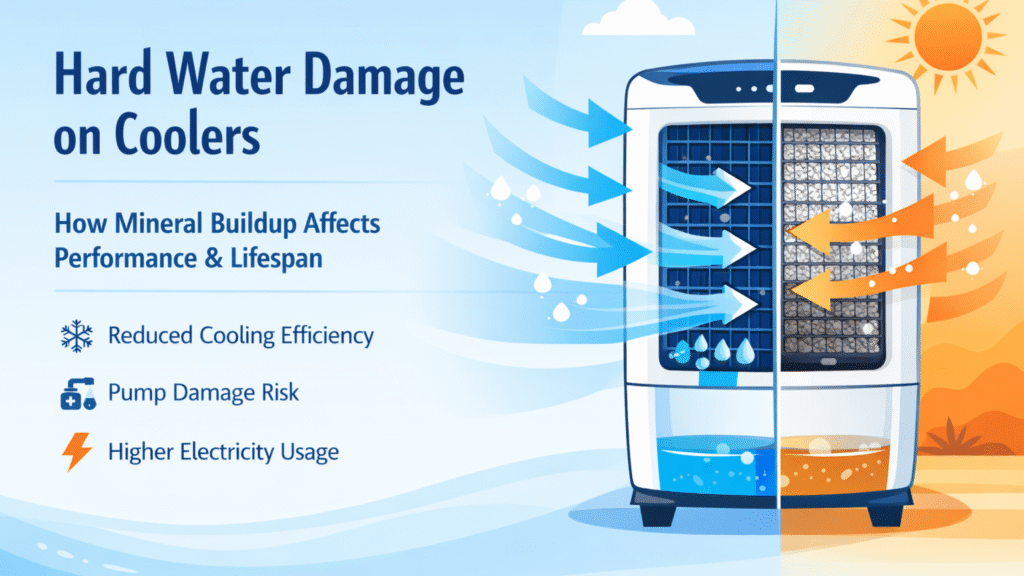
Hard Water Damage on Coolers: How Mineral Build-up Affects Performance & Lifespan
Protect Your Cooling Investment from Rajasthan’s Harsh Hard Water Conditions
Your cooler faces an invisible enemy every single day. Hard water minerals don’t just reduce efficiency—they dramatically shorten your cooler’s lifespan.
Lifespan Reduction
40-50%
With mineral damage
Water Hardness
300-400
PPM in Rajasthan
Pump Replacement
₹5,000
Average cost
Energy Waste
₹3,000
Per year wasted
At Siddham Coolers, we understand this challenge deeply because our customers face it daily. In this guide, we’ll explain exactly how hard water damages coolers, why mineral buildup matters, and what you can do to protect your cooling investment. This isn’t just about saving money—it’s about ensuring your home stays cool throughout Rajasthan’s intense summers.
💧
Understanding Hard Water: The Root Cause
What is Hard Water and Why Does It Affect Your Cooler?
Hard water contains high levels of dissolved minerals—primarily calcium and magnesium. When hard water circulates through your cooler’s pump system and cooling pads, these minerals don’t disappear. Instead, they accumulate on internal components, creating a crusty, scale-like coating that suffocates your cooling efficiency.
⚠️ Key Fact
Rajasthan’s groundwater is notoriously hard, with mineral content often exceeding 300-400 ppm (parts per million). For comparison, water below 60 ppm is considered soft. This means cooler owners in Rajasthan face severe mineral accumulation challenges that users in other regions rarely experience.
⚡
How Hard Water Damages Your Cooler
🌊
1. Reduced Cooling Efficiency Due to Mineral Deposits
When minerals coat your cooler’s pads and internal surfaces, they create an insulating barrier that blocks water absorption and airflow. Your cooling pads—whether fiber or honeycomb—rely on even water distribution to work effectively.
With mineral buildup:
- ▸Water flows unevenly across the pads
- ▸Dry spots develop on cooling pads
- ▸Air doesn’t pass through uniformly
- ▸Your cooler works harder but cools less
💡 Impact:
Your cooler runs all day but doesn’t deliver the cool air you expect. The temperature reduction drops from 12-15°C to just 5-8°C.
⚙️
2. Pump Failure from Hard Water Scale Accumulation
Your cooler’s pump is its heart. Hard water minerals create scale deposits inside the pump mechanism, causing serious damage and eventual failure.
- ▸Reduced water flow through the system
- ▸Pump grinding and unusual grinding noises
- ▸Complete pump failure (the most expensive repair)
A failed pump means your entire cooling system stops working. Replacement pumps cost ₹2,000-5,000 depending on capacity, plus labor charges.
🔧
3. Clogged Water Distribution Channels
Fiber coolers and plastic air coolers both have water distribution tubes and channels that spray water onto the cooling pads. Hard water minerals clog these tiny openings.
- ▸Uneven water distribution across pads
- ▸Some pads stay dry while others flood
- ▸Hot and cold spots in your room
- ▸Wasted water and wasted electricity
🔥
4. Corrosion of Internal Metal Components
While fiber body coolers resist external corrosion better than traditional metal coolers, their internal metal parts—brackets, pipes, pump body—still corrode when exposed to mineral-rich water. This accelerates aging and reduces cooler lifespan from 5-7 years to just 3-4 years.
✓
Why Fiber Coolers Still Suffer from Hard Water
You might think: “Siddham manufactures high-quality fiber coolers—don’t they resist hard water?”
✓ The Answer
The answer is nuanced. Fiber bodies resist external corrosion from humidity and weather, making them ideal for Rajasthan’s dry climate. However, the internal components—pump, pipes, and distribution system—still suffer from hard water mineral buildup regardless of whether your cooler’s body is fiber, plastic, or metal.
That’s why even premium fiber coolers need protection against hard water damage.
🔔
Signs Your Cooler Has Hard Water Buildup
Watch for These Warning Indicators:
1. White or Brownish Crusty Deposits
Open your cooler and inspect the pads and internal surfaces. If you see white, tan, or brown crusty buildup, that’s mineral scale.
2. Reduced Cooling Performance
Your cooler doesn’t cool as effectively as when new, even after cleaning the pads.
3. Weak Water Flow
The water spray from the distribution tubes feels weaker than before.
4. Strange Noises
Your pump makes grinding, squealing, or rattling sounds—a sign of mineral damage inside.
5. Foul Odors
Minerals trap bacteria and algae, creating musty smells even after cleaning.
6. Higher Electricity Bills
Your cooler consumes more electricity to achieve the same cooling because it’s working harder.
🛡️
How to Prevent Hard Water Mineral Buildup
💧
1. Use Distilled or Filtered Water
The most effective solution is avoiding hard water altogether. Use distilled water or water from an RO (reverse osmosis) filter. While this adds to your water costs (₹10-15 per liter for RO water), it significantly extends your cooler’s lifespan.
For budget-conscious users, use filtered water at least during peak summer months (April-June) when cooling demand is highest.
⚙️
2. Install a Water Softener
Hard water softeners remove calcium and magnesium ions, converting hard water to soft water. Home water softeners cost ₹8,000-15,000 initially but save money long-term by protecting all water-using appliances.
💊
3. Use Hard Water Treatment Chemicals
Commercial hard water treatment tablets (₹300-800 per pack) reduce mineral deposition. Add these to your cooler’s water tank as directed. Popular brands include:
- ▸Aqua Soft
- ▸Aquaguard treatment tablets
- ▸Coalspur minerals remover
⚠️ Important Note:
Always check compatibility with your specific cooler model before using treatment chemicals.
🧪
4. Descale Your Cooler Regularly
Use a descaling solution (mix white vinegar and water in a 1:1 ratio) to clean internal components:
- 1. Drain all water from the cooler
- 2. Pour the vinegar solution into the water tank
- 3. Let it sit for 2-3 hours
- 4. Run the cooler for 15-20 minutes to circulate the solution
- 5. Drain and rinse thoroughly with clean water
- 6. Refill with fresh water before using
Do this monthly during summer, quarterly during other seasons.
⭐
How Siddham Coolers Minimize Hard Water Damage
At Siddham Coolers, our fiber coolers and plastic air coolers are engineered specifically with hard water resistance in mind:
🔧 Premium Pump Quality
Our pumps use better-grade materials that resist scale accumulation for longer periods, ensuring consistent water flow even in hard water environments.
💧 Optimized Water Distribution
Our design ensures even water flow across all cooling pads, reducing stagnant areas where minerals concentrate and build up quickly.
🔨 Easy Access for Cleaning
Fiber cooler bodies are designed for easy maintenance—you can easily access and clean internal components without specialist tools or expertise.
✅ Comprehensive Warranties
Our cooling solutions include extended warranty coverage for manufacturing defects, giving you complete peace of mind and protection.
When you choose Siddham Coolers, you’re investing in a cooler designed to handle Rajasthan’s challenging hard water conditions better than any generic alternative on the market.
💰
The Long-Term Impact: Hard Water Costs You More Than You Think
Consider these financial implications:
Without Protection
3-4 years
Average cooler lifespan with mineral damage
With Protection
5-7 years
Average cooler lifespan without mineral damage
Pump Replacement
₹2,000-5,000
Plus labor charges and installation
Annual Cost Impact
₹3,000+
Electricity waste and repairs combined
Descaling Service Cost
₹500-1,500
Professional maintenance per year
⚡ Critical Insight
If you ignore hard water damage, you’re not saving money—you’re losing it through premature cooler failure, expensive emergency repairs, higher electricity bills, and the inconvenience of dealing with a non-functioning cooler during peak summer heat.
📋
Best Practices for Hard Water Cooler Maintenance
Your Monthly Maintenance Checklist:
✅ Week 1: Inspect cooling pads for white deposits
✅ Week 2: Check water flow from distribution tubes
✅ Week 3: Clean visible mineral buildup with vinegar solution
✅ Week 4: Test cooling performance and listen for unusual noises
Seasonal Deep Cleaning Guide:
Before Summer (March): Descale entire system, replace pads if needed
Mid-Summer (May): Monthly descaling intensifies—repeat weekly if possible
After Summer (September): Full system flush and comprehensive inspection
Winter Storage (November): Drain completely to prevent mineral concentration buildup
Protect Your Cooler from Hard Water Damage Today
Hard water mineral buildup is preventable but not ignorable. Whether you own a Siddham fiber cooler or any other brand, understanding how minerals damage your cooling system is the first step toward protecting your investment.
By using filtered water, descaling regularly, and choosing high-quality coolers designed for hard water resistance, you can extend your cooler’s lifespan by 2-3 years and maintain peak cooling performance throughout summer.
Ready to upgrade to a cooler designed for Rajasthan’s hard water conditions? Discover Siddham Coolers’ advanced fiber and plastic air coolers—built to resist mineral damage, deliver powerful cooling, and last longer in extreme climates.